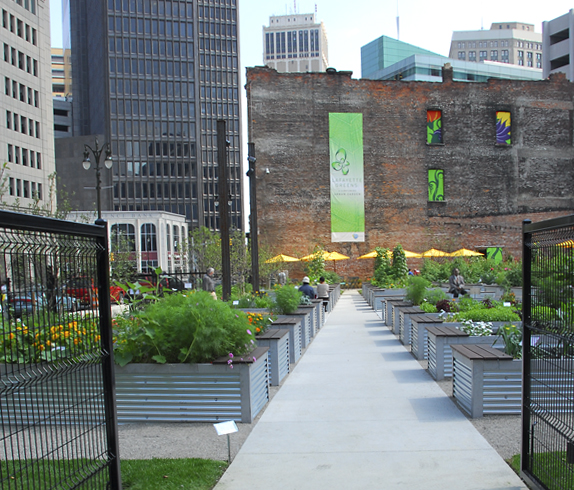
In 1923, when the Lafayette Building was constructed in downtown Detroit, the city was one of the cultural centers of the United States and home to an exploding automotive industry. Famous American architect C. Howard Crane designed the cutting edge, Italian Renaissance-style building in a unique ‘V’ shape to maximize the amount of natural light allowed in. Today, however, Detroit has fallen on harder economic times, and the once striking skyscraper at 144 West Lafayette was torn down in 2010 after being vacant for more than a decade.
Read more »
Terms:Community Building, Cultural Institutions, Downtown Development, Environment, Health & Wellness, Historic Preservation, IFC Best Practice, Neighborhood Revitalization, Parks, Playgrounds & Gardens, Urban
Lyz Crane draws on the work of practitioners and researchers to characterize the field of arts-based community development in which arts and culture can help achieve place based change related to the physical, social, and economic dimensions of place. This paper examines the premise that the existence of arts is considered a powerful end in itself, Crane then outlines the variety of ways that the actors and activities involved in arts and community development work can relate to and interact with each other to create sustainable communities. Looking at the cultural ecology of place, creative economy development focuses on fostering local creative businesses and supporting creative workers both in the arts and in supporting industries while cultural development may focus on preserving cultural assets—traditions, language, stories—or on building on them to create stronger, more connected communities. There is also a complex community development ecosystem of organizations, interests, and tools. Stakeholders may involve arts in their agendas, create arts programming, provide or develop arts spaces, employ artists, and/or partner with arts organizations. Indeed, both the arts and community development are part of the same ecosystem and all of these 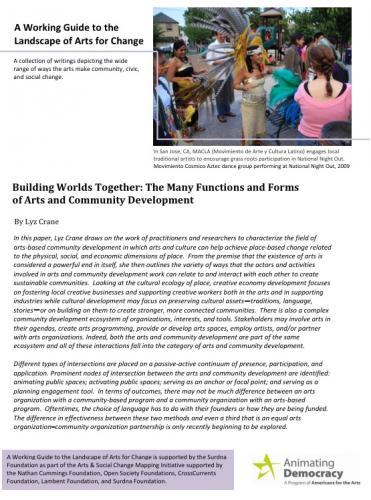 interactions fall into the category of arts and community development. interactions fall into the category of arts and community development.
Crane places different types of intersections on a passive-active continuum of presence, participation, and application. Prominent nodes of intersection between the arts and community development are identified: animating public spaces; activating public spaces; serving as an anchor or focal point; and serving as a planning engagement tool. Crane points out that, in terms of outcomes, there may not be much difference between an arts organization with a community-based program and a community organization with an arts-based program. Oftentimes, the choice of language has to do with their founders or how they are being funded. The difference in effectiveness between these two methods and even a third that is an equal arts organization–community organization partnership is only recently beginning to be explored.
Click here to download the whole document.
Read more »
Terms:2012, Arts & Culture, Business, CBC Report/Publication, Community Building, Community Development, Community Engagement, Creative Economy, Cultural Institutions, Featured, Other Reports/Publications, Placemaking, Public Art, Public-Private Partnerships
Housed in a stunning building designed by Frank Lloyd Wright, ASU Gammage at Arizona State University, one of the largest university-based theaters in the world, has been broadening its audience for many years. Its outreach extends to both immigrant and older adult audiences. Widely recognized for its work in Phoenix, ASU Gammage’s commitment becomes evident in the role played by one of its staff members: Michael Reed, the senior director of Cultural Participation and Programming, is responsible for developing and overseeing an astonishing array of performances, including explorations of theater arts for all ages, and programs highlighting the arts of various cultures.
The commitment to accommodating older adults, for example, was demonstrated while The Phantom of the Opera was at the theater for a four-week run. To better suit the preferences of older adult audiences, some performances were scheduled as matinees. Reed also explains that the house staff is very experienced in working with older adults and those who are frail or have disabilities. The staff works with ARTability, an Arizona organization that promotes accessibility to the arts for those with disabilities. Before each season begins, the staff reviews issues related to the Americans with Disabilities Act (ADA), though Frank Lloyd Wright’s design, while handsome, has made retrofitting ASU Gammage to meet the requirements of the ADA, and other evolving audience needs, quite difficult.
Read more »
Terms:2012, Aging, Aging in Place, AIP Best Practice, Arizona, Arts & Culture, City Leaders Institute on Aging in Place, Community Engagement, Cultural Institutions, Diversity, Education, Immigration, Intergenerational, Mobility, Youth
 photo credit Intergeneration Orchestra of Omaha photo credit Intergeneration Orchestra of Omaha
Symbolized by a rose in full bloom and a rose bud, the Intergeneration Orchestra of Omaha (IGO Omaha) joins older, experienced musicians with young musicians, using a love of music to bridge generation gaps. The Orchestra explains that, “The rose in full bloom signifies the lifetime of experience the older musicians bring to the group, while the rosebud represents the emerging talents of our younger artists.” This intergenerational program is a win-win for all involved; the young gain the opportunity to develop their skills, while older participants are able to play the music they love well past the age of retirement. Perhaps more significantly, both young and old find support and friendship as they pursue musical excellence.
With the goal of joining two distinct generations “through the universal language of music,” the IGO of Omaha was started by Chris Gillette, current project director of the Orchestra and the director of the Community Services Division of the Eastern Nebraska Office on Aging (ENOA), and former co-worker Cora Lee Bell. The Orchestra was initially funded by a grant from the Peter Kiewit Foundation, but has since been supported by numerous other grants, donations, memberships, fundraisers, and performance fees, and a sponsorship from ENOA. The Orchestra is run by an elected board of directors, which includes two younger and two older musicians.
Read more »
Terms:2012, Aging, Aging in Place, AIP Best Practice, Arts & Culture, City Leaders Institute on Aging in Place, Community Engagement, Cultural Institutions, Intergenerational, Life-Long Learning, Youth
 photo credit Lifetime Arts photo credit Lifetime Arts
Founded in 2008, Lifetime Arts promotes arts programming designed to engage older adults. A nonprofit organization, Lifetime Arts is committed to developing innovative programs which support creative aging and lifelong learning. To that end, Lifetime Arts offers a variety of services and programs. The organization is a clearinghouse for best practices; provides technical assistance, information services, and professional development to the individuals and organizations serving older adults through the arts; and helps to develop policy to enhance the quality of arts programs for older adults throughout the country.
As a service organization, Lifetime Arts developed Creative Aging in Our Communities: The Public Libraries Project, a program which demonstrates the viability and value of instructional arts programs offered in public libraries as a way to build a broad base of support for creative aging programming. The Public Libraries Project showcases the library as a center for access and learning for older adults; an “age-neutral” public space, the library is an accessible hub for older adults who are reluctant to go to senior centers, and is swiftly becoming an ideal center for programs that interest seniors.
Read more »
Terms:2012, Aging, AIP Best Practice, Arts & Culture, City Leaders Institute on Aging in Place, Community Engagement, Cultural Institutions, Culture Builds Communities, Life-Long Learning, New York City, NY, Rural
|
|

