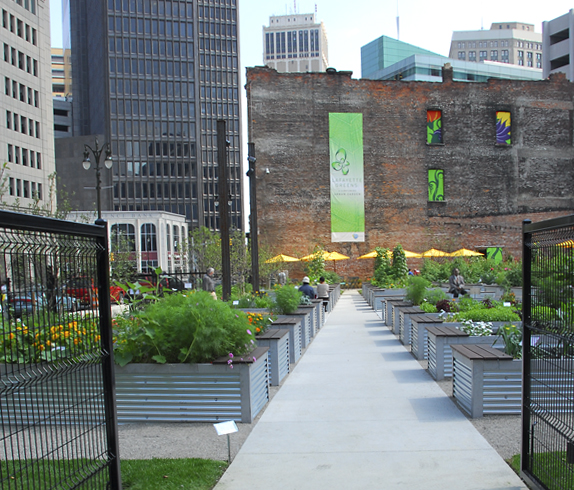
In 1923, when the Lafayette Building was constructed in downtown Detroit, the city was one of the cultural centers of the United States and home to an exploding automotive industry. Famous American architect C. Howard Crane designed the cutting edge, Italian Renaissance-style building in a unique ‘V’ shape to maximize the amount of natural light allowed in. Today, however, Detroit has fallen on harder economic times, and the once striking skyscraper at 144 West Lafayette was torn down in 2010 after being vacant for more than a decade.
Read more »
Terms:Community Building, Cultural Institutions, Downtown Development, Environment, Health & Wellness, Historic Preservation, IFC Best Practice, Neighborhood Revitalization, Parks, Playgrounds & Gardens, Urban
Inner-city Detriot may not be the first place one thinks of when looking to learn golf, but that is precisely where Renee Fluker founded her immensley successful Midnight Golf Program a dozen years ago. The program is a 30 week mentoring experience that not only teaches students about golf, but also about a number of essential life skills. The organization uses golf as a medium to teach children important life lessons, such as strategic thinking and how to deal with frustration and failure.
Read more »

Founded in 2002 in San Francisco, California, 826 is a nonprofit that runs eight writing and tutoring centers for students aged 6-18 nationwide. Each writing and tutoring center provides after-school tutoring at least four days a week, writing workshops to spark students’ interest in the subject, scholarships to helped under-privileged children gain access to a college education, and a variety of other initiatives to help the most at-risk youth further their educational endeavors.
Read more »
Walkability is synonymous with less traffic, a higher quality of life, and more vibrant streetscapes. A new Brookings Institution study—Walk this Way: The Economic Promise of Walkable Places in Metropolitan Washington, D.C., by Christopher B. Lienberger and Mariela Alfonzo—highlights the economics behind walkabaility, and why walkable areas are worth more than previously thought.
Read more »
 The D.C. Office of Planning (OP) has awarded a $75,000 “ArtPlace Arts and Culture Temporium” grant to Partners for Livable Communities (Partners) to develop and manage temporiums in underutilized spaces in the Deanwood neighborhood, one of the District’s earliest African American communities. The D.C. Office of Planning (OP) has awarded a $75,000 “ArtPlace Arts and Culture Temporium” grant to Partners for Livable Communities (Partners) to develop and manage temporiums in underutilized spaces in the Deanwood neighborhood, one of the District’s earliest African American communities.
Under this grant, Partners will develop and manage DeanwoodxDesign, a project that showcases the rich arts, cultural, historical, and green space assets of Deanwood and Ward 7 through a community-wide, intergenerational, and collaborative effort. This project engages artists and a diverse network of Deanwood institutions and stakeholders to cultivate community pride, showcase and create great art, and invigorate the creative economy.
Read more »
Terms:Announcements, Arts & Culture, CBC Best Practice, CBC Event, Community Building, Community Engagement, Creative Economy, Culture Builds Communities, Design, Multicultural, Neighborhood Revitalization, Placemaking, Public Art, Public-Private Partnerships, Urban, Washington, DC
|
|

