
Partners President Bob McNulty authored an article in Community Investments, the journal of the San Francisco Federal Reserve. In the article, titled The Partnership for a Green Dividend, McNulty makes the case for an integrated, comprehensive and place-based approach to the two imperatives of economic development and climate action, through a partnership between Partners for Livable Communities and Climate Prosperity Project. Drawing on the complementary skill sets and experiences of the two organizations, The Partnership would help communities assess and align those regional assets so important for success in the green economy and would focus efforts on four key constituencies: 1) low-income areas; 2) small business; 3) labor force; and 4) minority communities. The key, overarching objective of The Partership is to help communities maximize their opportunities in the green economy in a way that maximizes social equity and increases regional prosperity.
Read the article in full below, or click here for a direct link to the PDF.
Read more »
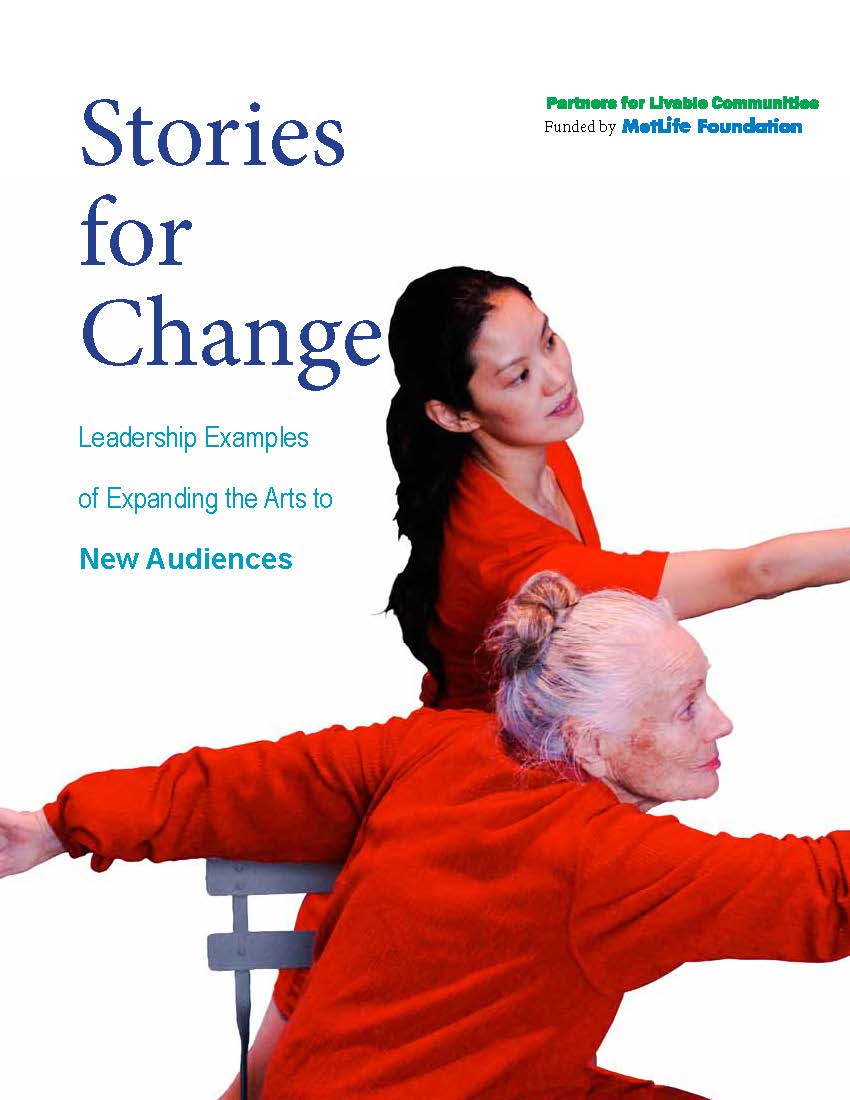 Partners for Livable Communities presents a PowerPoint presentation to accompany the 2012 Stories for Change report. This presentation is for community residents, city leaders, arts and cultural institutions, and many more to share the great stories of innovation and creativity featured in the Stories for Change report to begin discussions of reaching out to older adults and immigrants with the community. Partners for Livable Communities presents a PowerPoint presentation to accompany the 2012 Stories for Change report. This presentation is for community residents, city leaders, arts and cultural institutions, and many more to share the great stories of innovation and creativity featured in the Stories for Change report to begin discussions of reaching out to older adults and immigrants with the community.
Read more »
Partners announces the launching of the City Leaders Institute on Aging in Place (CLI), a one-year, pilot program focused on making local-level changes to facilitate aging in place.
This program is funded by MetLife Foundation and implemented by Partners for Livable Communities (Partners).
As part of this program, five Civic Teams were invited to participate as part of the 2012-2013 class. Each team has identified a specific goal for the year-long program.
- Arlington County, Virginia, aims to create a walkable, livable, urban environment that enhances welcoming connections and eliminates barriers between and among places, and enables all people to work, live, play, and visit in Arlington.
- Miami-Dade and Monroe counties, Florida, aims to identify and develop a platform to educate older people, public officials, and the community-at-large about issues related to elderly pedestrians, drivers, mass transit users, and travelers.
- Montgomery County, Maryland, aims to develop and implement a nonprofit and faith-based summit to clarify the needs of affordable, alternative housing options for older adults.
- Phoenix, Arizona, aims to develop new and enhanced service delivery mechanisms to connect older adults with their peers and with the community, to provide relevant activities and services, and to leverage their talents.
- San Diego, California, aims to increase community health and wellness among youngsters and older adults in the City of La Mesa and the La Mesa Spring Valley School District by implementing an intergenerational Safe Routes to School program and other strategic plans focused on health and wellbeing in this community.
Read more »
Terms:2012, Aging, Aging in Place, AIP Best Practice, AIP Event, AIP Press/Media, AIP Report/Publication, Announcements, City Leaders Institute on Aging in Place, Partners, Partners Events, Services
This year, the first of the Baby Boomers turn 65. But this milestone birthday may not be so eagerly celebrated, as our nation realizes the drastic impact this huge generation will have on our communities. Six years ago, the first edition of “The Maturing of America,” a report undertaken by the National Association of Area Agencies on Aging with groups representing local governments and city planners, found that most communities were not properly prepared for the impact of an increasing aging population: the age 65-plus population is expected to double by 2030.
Read more »

Culture Connects All, a benchmark report by Partners for Livable communities funded by MetLife Foundation, offers new audience-building opportunities for arts and cultural organizations to engage two of America’s fastest growing populations: immigrant and older adult populations.
The 2010 census confirms what many have observed over the past decade—the population is growing older, and in many areas more diverse. And this change is happening across the face of the nation. Two rapidly expanding population groups present a timely opportunity for communities and their arts and cultural institutions to rethink and retool their outreach.
Click Here to Download the Publication
Read more »
|
|

