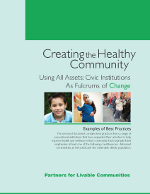
Partners compiled a collection of best practices of traditional community institutions incorporating health and wellness into their agenda and programming to improve community health. The best practices focus on improving the health of at least one of three constituencies: distressed communities, at-risk youth, and the vulnerable elderly.
Examples of institutions include arts and culture organizations, botanical gardens, community development corporations (CDCs), faith-based organizations, libraries, museums, public markets, and zoos.
Click here to download Creating the Healthy Community - Using All Assets: Institutions as Fulcrums of Change
Read more »
Terms:Aging, Community Building, Community Development, Community Engagement, Creating The Healthy Community, Cultural Institutions, Health & Wellness, Healthy Communities, Institutions as Fulcrums of Change , Intergenerational, Libraries, Program Areas, Public Health

For residents of Chicago’s northern suburbs, the Chicago Botanic Garden is much more than just a collection of colorful plants and flowers. Since it opened more than 40 years ago, the 385 acre grounds have served as an important center for community activity and education. The Garden is home to 26 separate gardens and four natural areas, as well as a conservation science education center and a library with one of the country’s largest collections of botanical books. The grounds are also host to numerous community events and educational courses throughout the year.
Read more »
Terms:Arts & Culture, Chicago, IL, Community Development, Creative Economy, Cultural Institutions, Design, Environment, IFC Best Practice, Institutions as Fulcrums of Change , Parks, Playgrounds & Gardens

The Habitot Children’s Museum first opened its doors in downtown Berkley in 1998, and the institution has served over 950,000 residents of underserved communities in the Bay Area since. The 7,000 sq. foot facility is home to exhibits that help teach kids about the value of physical activity, water preservation, and art and culture. The hands-on Museum encourages early childhood education and aims to help support a generation of curious and creative kids.
Read more »
Terms:Arts & Culture, Community Building, Creative Economy, Cultural Institutions, Downtown Development, Education, Families, IFC Best Practice, Institutions as Fulcrums of Change , Museums, Youth
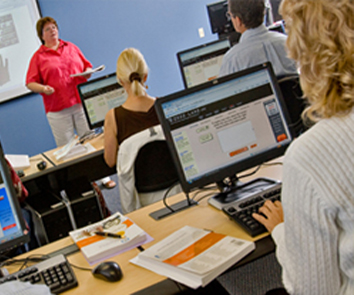
In today’s economic climate, trying to find a high-paying job without a college education is nearly impossible. That is why the leadership at Indiana University-Perdue University Indianapolis started their Community Learning Network that focuses on continuing education and lifelong learning. Each year the network provides more than 600 continuing education classes to over 7,000 residents in Central Indiana.
Read more »
The Strive Partnership is an effort launched by community leaders in the Cincinnati region in 2006 that relies on innovative strategies to improve student education outcomes. The Partnership has designed a strategic approach to education reform that can be applied to communities throughout the country. The approach relies on a collaborative effort from community stakeholders from all sectors of the economy to encourage learning and development beyond the walls of their schools.
Read more »
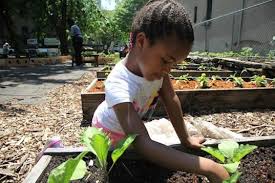
Head Start is a federal program designed to promote school readiness by enhancing the cognitive and emotional development of pre-school aged children. Through a program called “Eat Play Grow,” a series of obesity prevention classes are offered by the Children’s Museum of New York and the National Health Institute to be held in classrooms throughout New York City. Nonprofit groups throughout low-income areas in New York teach classes to children in underserved communities. Classes are held at common neighborhood institutions, such as community centers and libraries.
Read more »

The U.S. Armed Forces Retirement Home in Washington, D.C., commonly referred to as the ‘Soldiers’ Home,’ is one of the country’s oldest veterans’ retirement homes and certainly one of the most beautiful. Located on a 273-acre campus in Northwest D.C., the Home’s green pastures and tranquil lakes sit in stark contrast to the developed neighborhoods of the surrounding community. Since the home opened in 1851, the retirement community has been home to thousands of retired elderly and disabled veterans in the Washington area.
Read more »
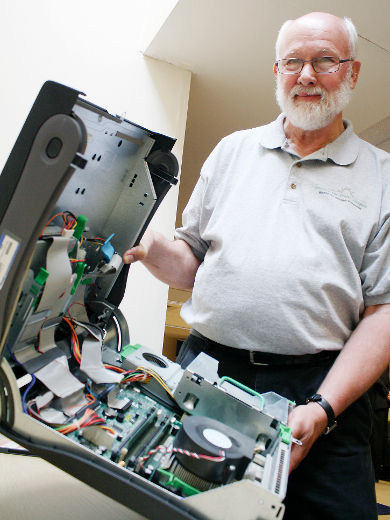
Project Phoenix is an intergenerational program based in Wellend, Ontario, just outside of Niagara, run jointly by the nonprofits Seniors for Youth Niagara and Youth Resources Niagara. The program aims to close the gap between seniors and youth for the purpose of improving the community by giving senior volunteers a chance to interact and share their knowledge and experience with at-risk youth in the area.
Read more »
When Dr. Gordon Streib, a sociology professor at the University of Florida, first pitched the idea of sponsoring a retirement community on the UF campus in 1997, it was understandably met with skepticism by the University leadership. It would seem difficult for the late-night lifestyles of college students and the generally more peaceful temperaments of senior citizens to coexist. Nearly 10 years after the retirement community opened its doors in 2004, however, the establishment of the Oak Hammock Retirement Home has proven to be such a resounding success that there is already a waiting list to get in.
Read more »

Bird Tales is a therapeutic program for Alzheimer’s patients created by Randy Griffin, a dementia care specialist, and Ken Elkins, an Audubon Society employee. The two educate nursing-home staff members on ways to attract birds to their grounds, and give Alzheimer’s patients the tools necessary to develop bird-watching as a hobby. Participants get the chance to interact with birds on a multi-sensory level and come away with a meaningful experience that they can share with others. In nursing homes where this program has been implemented, the facilities have reported a reduction in the amount of medication necessary to treat Alzheimer’s patients, showing that the bird-watching is making a difference.
Read more »

Partners for Livable Communities (Partners) releases Arts Organizations and Public Health, a guide to creating partnerships between art and health organizations. This primer was designed for the arts organization that wishes to initiate programming focused on local health issues, or create partnerships with health groups in order to best meet the needs of the community. Arts Organizations and Public Health identifies best practices of diverse arts organizations from around the United States to inform this work. The best practices can be used as references, and are cited throughout the publication to correlate with text.
Read more »
Tuesday August 9th will be a big day of change for former Mayor of Youngstown, Ohio and Partners Trustee Jay Williams. Williams will be taking up his new appointment by President Obama as the Director of the Office of Recovery for Auto Communities and Workers which assists areas of the country negatively affected by the retrenchment of the auto industry to identify federal resources that may be used as part of their recovery efforts. By virtue of his being mayor of the largest community in the Mahoning Valley, Williams has had a front-row seat to the reorganization of the auto industry.
Jay Williams was instrumental in helping Partners develop its Institutions as Fulcrums of Change program strategy; which focused on how we can use libraries, museums, performing arts centers, boys and girls clubs, and chambers of commerce to reposition communities that have suffered devastation in the downturn and in the new economic order, and how can they use their creativity and neutrality to be centers of excellence, i.e. fulcrums of change. With the focus on utilizing anchor institutions as centers of redevelopment in Youngstown, Williams worked with Partners to spear the Ten Living Cities Network, a consortium working for identity preservation and economic resurgence in the Ten U.S. Cities most affected by the post-industrial age.
Prior to his appointment to the Office of Recovery for Auto Communities and Workers, Jay Williams was the City of Youngstown’s first African-American mayor, and being first elected at 33 years old, was also it’s youngest. Under the leadership of Mayor Williams, the Youngstown 2010 Vision/Planning “right-sizing” initiative has been recognized and rewarded by a number of notable organizations including, The Wall Street Journal, U.S. News and World Report, the American Planning Association, and Governing Magazine. In August 2009, Entrepreneur Magazine listed the city of Youngstown among the ten best cities in the United States to start a business. Mayor Williams was also recognized in 2009 as one of Governing Magazine’s public officials of the year. He was also the recipient of the 2007 John F. Kennedy New Frontier Award.
You can read more about Jay Williams appointment from the U.S. Department of Labor
Read more »
Undoubtedly the turn of the 21st century has been a crossroads for communities across America. Planners are becoming more uncertain of which road to take to towards livability, the latest and most thought out models of revitalization being thrown into disarray by constant redevelopments in technology and the unforseeable factors that mediate the outcome. But as the unfolding of the digital age propels us into the unknown, there is one thing that is certain—education is a key to building a more vibrant and sustainable community.
Read more »
How does a city aspire to be livable when the outside public seemingly brands it as ‘dying?’ How does the city grow when it is told that is 'shrinking’? With eyes that are turning away from the core industrial cities and onto the technological hubs of the twenty-first century: can the city sustain itself? For Mayor Jay Williams of Youngstown, OH, hearing his city being labeled by Forbes Magazine as one of Americas 10 Fastest-Dying Cities, inspired him to take the city in a new direction; one that leveraged successful development upon its own definition.
At the “ Building Livable Communities” forum held at Washington, DC's Hirshhorn Museum and Sculpture Garden on September 22, 2010, Mayor Williams held a detailed discussion on how civic institutions in Youngstown redefined their role to promote dynamic change as amenity rich centers.
Public libraries have transformed themselves from mere book-lenders into hubs of social and economic activity. In a recent column, journalist Neal Peirce details how libraries are adding new services ranging from lending gardening tools and hosting chess club meetings, to providing job search assistance and English instruction. Peirce quotes Partners’ president Robert McNulty regarding the transformation: "Central libraries, notes Robert McNulty of Partners for Livable Communities, can be “the great good place in the city” — as a literacy, Internet and special film center, or as a place for lectures, for local performing arts and exhibitions. Or as a coffee house. Or as an information center for visiting tourists, or a safe place for kids."
Long considered by many as the center of high society and fine art, museums have established themselves as the elite foundation for what many museum directors proudly describe as the, “cathedrals of culture.” In vibrant metropolises, urban museums have sought to find a composite group of high class patrons amongst the density and heterogeneous nature of the city. Up until recently, museum collections sought out only the most exclusive and rarest of art as a top priority in the agenda held by longtime directors. In the current era, however; a major trend has occurred amongst many of the directors who are facilitating new programs that allow each institution to provide a focused area for creating a multicultural setting in the local community.
Read more »
America’s public libraries, fast turning themselves into “one-stop shops” for digital job searches, appear to be staging one of their great historic transformations.
Read more »
Nassau County, NY with its growing immigrant population, has witnessed a 107 percent increase in Hispanics since 1990. Recognizing the local demographics of their community are rapidly changing, the Nassau County Museum of Art has created a new outreach program to both attract and to serve this growing community. Nassau County Museum of Art collaborated with Queensborough Community College’s adult literacy program for English language learners to create Culture and Literacy through Art (CALTA).
As many traditional economic drivers leave our cities, institutions like libraries, colleges, and arts organizations are now the key to supporting vibrant communities. Given the right leadership and resources, these “anchor” institutions can act as fulcrums of change for leveraging stronger development agendas. In order to achieve this goal, institutional leaders across the country are seeking guidance on how to use their own missions to improve their communities. A new report, released by CEOs for Cities and Living Cities, responds to this call for direction. How to Behave Like an Anchor Institution presents six case studies of institutions that have successfully become “community anchors, developers and forces of change for their neighborhoods.” Read more about the project and download the full report by clicking here. -- Click here to learn more about Partners’ related program, Institutions as Fulcrums of Change, which seeks to initiate changes in the philosophy and programming of community institutions to help them strengthen their communities.
by administrator
on March 15, 2010
 This brochure highlights the prevalent issues of today affecting all of our communities and provides concrete examples of the myriad types of institutions that have become “Fulcrums of Change” for the betterment of the people and neighborhoods where they are located.
Read more »
Terms:2009, Aging, Arts & Culture, Community Building, Creative Economy, Cultural Institutions, Families, Health & Wellness, IFC Report/Publication, Institutions as Fulcrums of Change , Multicultural, Partners Reports/Publications, Suburban, Workforce Development
|
|

