As the baby-boomer population all reach the age of retirement, many older individuals are going to be forced into assisted living facilities. This article featured on PlaceMakers by Ben Brown highlights the ElderSpirit Community in Abingdon, VA, which on a relatively small budget, has created a community for older individuals that emphasizes people, skills, and needs.
"Among the Big Issues awaiting communities after we shake off the post-recession blues is what to do about demography. Particularly the part about America’s aging population.
The first-borns among the 76-million-strong Baby Boomer generation reached 65 in 2011. And over the next three decades, the geezer slice of the population pie will swell to 20 percent, compared to a little more than 13 percent in 2010. Take a look at the chart below, compiled from Census projections and pulled from the informative Alliance for Aging site.
That’s more than 88 million folks 65-plus, with the fastest growing cohorts the “oldest-old” segments of 80-plus.
I have a special interest in this topic, given that I’m among those leading-edge Boomers who have reconfigured commerce and culture to suit our tastes over the last half-century. It’s been a great run.
By now, just about everybody not invited to our long-running generational fiesta is tired of indulging Boomer fantasies. Sorry. Since we’re still running lots of stuff and still hoarding most of America’s financial assets, there’s more to come. Currently, we’re in the middle of one of our periodic – and probably our last – reality denial exercises. This is the one where we’re pretending Big Pharma, robots, electric cars and Dr. Oz will extend our playtime into infinity. You know, “60 is the new 40.” Unlike previous Boomer reality ducks, however, this one is going to be tough to buy or lie our way out of....."
Read More.
Read more »
“I know that we—the American people—have the ability: to lead the world; to meet today’s energy challenges; to cross the bridge to a cleaner, more secure world; and most importantly, to leave our grandchildren with a place where they can thrive.” – Jim Rogers at the 2012 Democratic National Convention
After welcoming and thanking all those who helped make the 2012 Democratic National Convention possible in Charlotte, North Carolina, Jim Rogers, co-chair of the Charlotte Host Committee at the Convention, began his address by proclaiming that he was not there as a, “Democrat, Republican, policy pundit, or CEO,” but rather, he was there as a concerned grandfather. Rogers continued with his speech by calling for a more broad based long-term effort toward a future of affordable, reliable, and cleaner energy. He went on to state that, “energy is more than a partisan issue. It’s an American issue. And a global issue.”
Jim Rogers’s commitment to identifying and implementing better practices for cleaner and more efficient energy sources has made him a leading figure in not only the energy industry, but the entire environmental movement. As chairman, president, and CEO of Duke Energy, one of the nation’s leading energy providers, Rogers’s prestigious career in the world of energy and politics began after being hired as an Assistant Attorney General for the Commonwealth of Kentucky, where he advocated for the state’s consumers in gas, electric, and telephone rate cases. He was then appointed to Deputy General Counsel for litigation and enforcement for the Federal Energy Regulatory Commission (FERC), and Executive Vice President of interstate pipeline for the Enron Gas Pipeline Group. After joining PSI Energy as the company’s chairman, president, and CEO in 1988, he served as chairman and CEO of Cinergy for more than 11 years before its merger with Duke Energy.
In addition, Rogers has been recognized as one of the most outspoken and respected figures worldwide in the energy industry. In 2011, Rogers was awarded the Asia Society of Washington’s International Business Leadership Award, as well as U.S.-China Policy Foundation’s Global Executive Leadership Award for his work with China to help strengthen the relationship between the two nations, and bring energy to the forefront of global issues. Rogers has testified more than 20 times before U.S. Congressional Committees, has spoken at international forums such as the United Nations General Assembly, the World Economic Forum, the Clinton Global Initiative, and in 2009, Newsweek named him one of “The 50 Most Powerful People in the World.”
Rogers has also done extensive civic work in his current hometown of Charlotte, North Carolina, co-chairing the city’s $82 million campaign to construct a new cultural campus in uptown Charlotte, and by co-chairing Charlotte’s committee to bring the 2012 Democratic National Convention to the city.
Duke Energy has been the largest electric power holding company in the United States for years, supplying energy to approximately 7 million U.S. customers, and was recently named to the Dow Jones Sustainability Index for North America for the seventh consecutive year. With Jim Rogers leading the way, not only does Duke Energy have a bright future ahead of them, but the rest of the world, and especially his grandchildren do as well.
Read more »
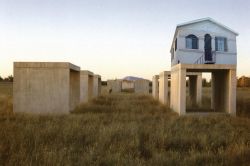 Photo Credit: Alan Rosenblum Photo Credit: Alan Rosenblum
Courtesy of Estudio Teddy Cruz
Home to the nation’s busiest United States-Mexico border crossing, San Ysidro is a suburb of San Diego, California, that lies just north of Tijuana, Mexico. Comprising mostly third- to first- generation immigrants, San Ysidro is often ignored, viewed as a place to pass through on the way to and from the border. Many San Ysidro-Tijuana families live in a bi-national condition, a state of being that finds families, work, education, affordable housing, health care, and economies tied to one another, and one that is currently struggling with the hot spots of drug cartel violence. Casa Familiar, a San Ysidro-based nonprofit organization, is working to invigorate the community by advocating for and assisting the residents in such areas as immigration services, education, and job placement[i].
Lyz Crane draws on the work of practitioners and researchers to characterize the field of arts-based community development in which arts and culture can help achieve place based change related to the physical, social, and economic dimensions of place. This paper examines the premise that the existence of arts is considered a powerful end in itself, Crane then outlines the variety of ways that the actors and activities involved in arts and community development work can relate to and interact with each other to create sustainable communities. Looking at the cultural ecology of place, creative economy development focuses on fostering local creative businesses and supporting creative workers both in the arts and in supporting industries while cultural development may focus on preserving cultural assets—traditions, language, stories—or on building on them to create stronger, more connected communities. There is also a complex community development ecosystem of organizations, interests, and tools. Stakeholders may involve arts in their agendas, create arts programming, provide or develop arts spaces, employ artists, and/or partner with arts organizations. Indeed, both the arts and community development are part of the same ecosystem and all of these 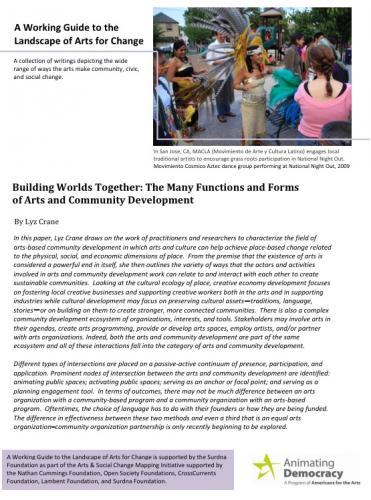 interactions fall into the category of arts and community development. interactions fall into the category of arts and community development.
Crane places different types of intersections on a passive-active continuum of presence, participation, and application. Prominent nodes of intersection between the arts and community development are identified: animating public spaces; activating public spaces; serving as an anchor or focal point; and serving as a planning engagement tool. Crane points out that, in terms of outcomes, there may not be much difference between an arts organization with a community-based program and a community organization with an arts-based program. Oftentimes, the choice of language has to do with their founders or how they are being funded. The difference in effectiveness between these two methods and even a third that is an equal arts organization–community organization partnership is only recently beginning to be explored.
Click here to download the whole document.
Read more »
Terms:2012, Arts & Culture, Business, CBC Report/Publication, Community Building, Community Development, Community Engagement, Creative Economy, Cultural Institutions, Featured, Other Reports/Publications, Placemaking, Public Art, Public-Private Partnerships
 photo credit National Senior Games AssociationThe Good Life Games of Pinellas County encourage adults 50 and over to participate in their own “Senior Olympics,” to promote athleticism and healthy lifestyles. Many older adults are intimidated by the idea of athletic competition, out of fear that an injury or lameness could permanently limit their mobility. Specifically designed to meet the physical capabilities of older adults, the Olympic-style games include archery, track and field, swimming, cycling, and others. Players in Good Life Games are also eligible for statewide and national competitions. photo credit National Senior Games AssociationThe Good Life Games of Pinellas County encourage adults 50 and over to participate in their own “Senior Olympics,” to promote athleticism and healthy lifestyles. Many older adults are intimidated by the idea of athletic competition, out of fear that an injury or lameness could permanently limit their mobility. Specifically designed to meet the physical capabilities of older adults, the Olympic-style games include archery, track and field, swimming, cycling, and others. Players in Good Life Games are also eligible for statewide and national competitions.
Read more »
|
|

