Cincinnati Magazine published an article on October 30th outlining the recent history of Wilmington, Ohio. Wilmington, like so many small towns across the country, suffered immensely during the recession. In 2008 the town’s largest employer, DHL Shipping, announced that it planned to end its partnership with Airborne Express, who operated the Wilmington Air Park, and find another U.S. partner. The loss of nearly 10,000 jobs meant the city’s unemployment rate skyrocketed from 3 percent in 2007 to 19 percent by 2010. Wilmington quickly became the face of the recession, and large scale impact the economic downturn had received media attention from many major news outlets, including the New York Times and 60 minutes.
Read more »
Lyz Crane draws on the work of practitioners and researchers to characterize the field of arts-based community development in which arts and culture can help achieve place based change related to the physical, social, and economic dimensions of place. This paper examines the premise that the existence of arts is considered a powerful end in itself, Crane then outlines the variety of ways that the actors and activities involved in arts and community development work can relate to and interact with each other to create sustainable communities. Looking at the cultural ecology of place, creative economy development focuses on fostering local creative businesses and supporting creative workers both in the arts and in supporting industries while cultural development may focus on preserving cultural assets—traditions, language, stories—or on building on them to create stronger, more connected communities. There is also a complex community development ecosystem of organizations, interests, and tools. Stakeholders may involve arts in their agendas, create arts programming, provide or develop arts spaces, employ artists, and/or partner with arts organizations. Indeed, both the arts and community development are part of the same ecosystem and all of these 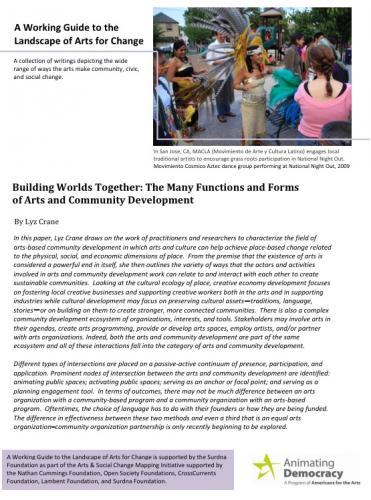 interactions fall into the category of arts and community development. interactions fall into the category of arts and community development.
Crane places different types of intersections on a passive-active continuum of presence, participation, and application. Prominent nodes of intersection between the arts and community development are identified: animating public spaces; activating public spaces; serving as an anchor or focal point; and serving as a planning engagement tool. Crane points out that, in terms of outcomes, there may not be much difference between an arts organization with a community-based program and a community organization with an arts-based program. Oftentimes, the choice of language has to do with their founders or how they are being funded. The difference in effectiveness between these two methods and even a third that is an equal arts organization–community organization partnership is only recently beginning to be explored.
Click here to download the whole document.
Read more »
Terms:2012, Arts & Culture, Business, CBC Report/Publication, Community Building, Community Development, Community Engagement, Creative Economy, Cultural Institutions, Featured, Other Reports/Publications, Placemaking, Public Art, Public-Private Partnerships
Recess for seniors may sound unusual, but it is just one of many volunteer roles that the Rochester School District’s Office of Extended School Programs has developed to increase community involvement in its elementary schools. The Rochester School Department defines as its goal the enhanced achievement and academic success of students who participate in extended-school programs. Volunteers play a key role in support of these programs. The Office organizes enrichment programs by sharing resources, creating partnerships with businesses and community organizations, and involving parents.
These programs have proven to be a boon to both students and volunteers, many of whom are older adults. Intergenerational activities benefit senior volunteers, who take pleasure in giving back to their communities and participating in a structured social environment. They often exult in the joy of working with children.
Read more »
 photo credit SCOPE photo credit SCOPE
SCOPE’s (Sarasota County Openly Plans for Excellence) mission is to connect and inspire citizens to create a better community. A private nonprofit, SCOPE is a convener, catalyst and facilitator, partnering with residents to generate collective action around issues affecting quality of life. It is fitting that Sarasota County, as the oldest in the nation and with 30 percent of its residents over 65, focuses considerable attention on aging. Founded in 2001, SCOPE collaborates with Sarasota County residents, elected officials, and community organizations to support broad-based undertakings led by citizens, to solve a variety of community concerns. Initiatives have addressed the environment, transportation, family violence, community change, and the needs of aging residents, to name just a few. All SCOPE activities address issues that strongly influence the quality of life in Sarasota County.
With Sarasota County’s large older adult population, it is not surprising that SCOPE’s perspective on aging is both positive and constructive. It views Sarasota County’s older adults as assets to and active participants in the community. In 2005, to examine the consequences of aging, the opportunities and challenges, SCOPE launched the initiative Aging: The Possibilities. Over 900 residents participated in many discussions, and presentations by experts covered a range of issues relevant to community planning for aging residents—and on their great capacity for enhancing the quality of life in Sarasota County.
Read more »
Terms:2012, Aging, Aging in Place, AIP Best Practice, Chamber of Commerce, City Leaders Institute on Aging in Place, Community Building, Housing, Philanthropy/Community Foundation, Public-Private Partnerships, Transportation
 photo credit Phoenix New Times photo credit Phoenix New Times
The Arizona Science Center has long engaged adult volunteers age 50+ as docents, and in
other conventional volunteer roles, but only recently the Center began to tap volunteers’ science and technology skills to enhance its programs. Jan Stonebraker, the Science Center volunteer coordinator of four years, entered the position as the Center launched a large travelling exhibition titled Body Worlds 3, an exploration of biology and anatomy.
Stonebraker identified knowledgeable volunteers to help staff the exhibition. At around the same time, the Virginia G. Piper Charitable Trust funded a leadership grant program, through the National Council on Aging (NCOA), to engage adult volunteers age 50+ in leadership roles. The Science Center development staff and Stonebraker designed a program that would qualify for a grant. Stonebraker found that many volunteers were retired mechanical and electrical engineers, information technology specialists, and science teachers who wanted to help the Center. It made eminent sense to use their skills to enhance educational programs.
Read more »
Terms:2012, Aging, Aging in Place, AIP Best Practice, Arizona, City Leaders Institute on Aging in Place, Community Engagement, Education, Intergenerational, Jobs, Life-Long Learning, Museums, Public-Private Partnerships
|
|

