Cincinnati Magazine published an article on October 30th outlining the recent history of Wilmington, Ohio. Wilmington, like so many small towns across the country, suffered immensely during the recession. In 2008 the town’s largest employer, DHL Shipping, announced that it planned to end its partnership with Airborne Express, who operated the Wilmington Air Park, and find another U.S. partner. The loss of nearly 10,000 jobs meant the city’s unemployment rate skyrocketed from 3 percent in 2007 to 19 percent by 2010. Wilmington quickly became the face of the recession, and large scale impact the economic downturn had received media attention from many major news outlets, including the New York Times and 60 minutes.
Read more »

ArtSpace is a national organization, headquartered in Minneapolis, which works to transform communities through the arts. The organization runs 33 affordable, artist-housing facilities throughout the country, in both urban and rural areas, that help improve the livability of their neighborhoods by repurposing old or abandoned buildings to attract artists to live and work in the community.
Read more »
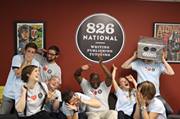
Founded in 2002 in San Francisco, California, 826 is a nonprofit that runs eight writing and tutoring centers for students aged 6-18 nationwide. Each writing and tutoring center provides after-school tutoring at least four days a week, writing workshops to spark students’ interest in the subject, scholarships to helped under-privileged children gain access to a college education, and a variety of other initiatives to help the most at-risk youth further their educational endeavors.
Read more »
Lyz Crane draws on the work of practitioners and researchers to characterize the field of arts-based community development in which arts and culture can help achieve place based change related to the physical, social, and economic dimensions of place. This paper examines the premise that the existence of arts is considered a powerful end in itself, Crane then outlines the variety of ways that the actors and activities involved in arts and community development work can relate to and interact with each other to create sustainable communities. Looking at the cultural ecology of place, creative economy development focuses on fostering local creative businesses and supporting creative workers both in the arts and in supporting industries while cultural development may focus on preserving cultural assets—traditions, language, stories—or on building on them to create stronger, more connected communities. There is also a complex community development ecosystem of organizations, interests, and tools. Stakeholders may involve arts in their agendas, create arts programming, provide or develop arts spaces, employ artists, and/or partner with arts organizations. Indeed, both the arts and community development are part of the same ecosystem and all of these 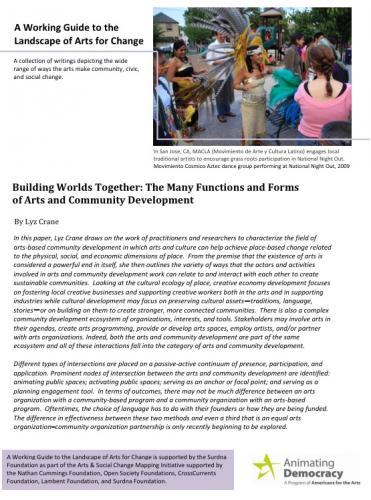 interactions fall into the category of arts and community development. interactions fall into the category of arts and community development.
Crane places different types of intersections on a passive-active continuum of presence, participation, and application. Prominent nodes of intersection between the arts and community development are identified: animating public spaces; activating public spaces; serving as an anchor or focal point; and serving as a planning engagement tool. Crane points out that, in terms of outcomes, there may not be much difference between an arts organization with a community-based program and a community organization with an arts-based program. Oftentimes, the choice of language has to do with their founders or how they are being funded. The difference in effectiveness between these two methods and even a third that is an equal arts organization–community organization partnership is only recently beginning to be explored.
Click here to download the whole document.
Read more »
Terms:2012, Arts & Culture, Business, CBC Report/Publication, Community Building, Community Development, Community Engagement, Creative Economy, Cultural Institutions, Featured, Other Reports/Publications, Placemaking, Public Art, Public-Private Partnerships

By Diana Nash of the Pink Line Project on July 12, 2012
There is a buzzword circulating in the DC arts scene that I had not heard about until I returned to the city two months ago. While the concept of using the arts to spur economic and community development is not new, DC is getting attention for the success of its “Arts and Culture Temporiums” since the first one launched along the H Street NE corridor in 2010. Temporiums fall under the larger category of the Temporary Urbanism Initiative, a project undertaken by the DC Office of Planning. The goal behind the initiative, and more specifically, temporiums, is to activate vacant or underutilized spaces by using them to showcase the talent of local artists and other creative entrepreneurs, along with the retail potential that lies within emerging neighborhoods. Think of them as “Pop Ups” that stay around a little longer and have greater potential benefits for the communities where they take place. Jessica Scheuerman, of Partners for Livable Communities, explains that temporiums allow people to “take risks, explore partnerships, and to commit to something” without the burden of a long-term commitment. Temporiums connect creative people seeking affordable space in their neighborhoods with landlords who have the available space that they haven’t been able to lease. It is a smart and increasingly popular concept that lays the groundwork for longer-term collaboration between property owners and neighborhood entrepreneurs.
Building on the success of earlier temporiums, the Office of Planning is targeting four emerging creative neighborhoods to benefit from a $250,000 grant to the city from ArtPlace, an unprecedented new private-public organization. ArtPlace is part of a national “creative place-making” movement that aims to drive revitalization across the country with arts at the center of economic development. The launch of DeanwoodxDesign marks the next step in the OP/ArtPlace grant initiative.
Read more »
Terms:2012, Announcements, Arts & Culture, CBC Press/Media, Community Building, Creative Economy, Culture Builds Communities, Neighborhood Revitalization, Other Events, Public Art, Washington, DC
|
|

