“I know that we—the American people—have the ability: to lead the world; to meet today’s energy challenges; to cross the bridge to a cleaner, more secure world; and most importantly, to leave our grandchildren with a place where they can thrive.” – Jim Rogers at the 2012 Democratic National Convention
After welcoming and thanking all those who helped make the 2012 Democratic National Convention possible in Charlotte, North Carolina, Jim Rogers, co-chair of the Charlotte Host Committee at the Convention, began his address by proclaiming that he was not there as a, “Democrat, Republican, policy pundit, or CEO,” but rather, he was there as a concerned grandfather. Rogers continued with his speech by calling for a more broad based long-term effort toward a future of affordable, reliable, and cleaner energy. He went on to state that, “energy is more than a partisan issue. It’s an American issue. And a global issue.”
Jim Rogers’s commitment to identifying and implementing better practices for cleaner and more efficient energy sources has made him a leading figure in not only the energy industry, but the entire environmental movement. As chairman, president, and CEO of Duke Energy, one of the nation’s leading energy providers, Rogers’s prestigious career in the world of energy and politics began after being hired as an Assistant Attorney General for the Commonwealth of Kentucky, where he advocated for the state’s consumers in gas, electric, and telephone rate cases. He was then appointed to Deputy General Counsel for litigation and enforcement for the Federal Energy Regulatory Commission (FERC), and Executive Vice President of interstate pipeline for the Enron Gas Pipeline Group. After joining PSI Energy as the company’s chairman, president, and CEO in 1988, he served as chairman and CEO of Cinergy for more than 11 years before its merger with Duke Energy.
In addition, Rogers has been recognized as one of the most outspoken and respected figures worldwide in the energy industry. In 2011, Rogers was awarded the Asia Society of Washington’s International Business Leadership Award, as well as U.S.-China Policy Foundation’s Global Executive Leadership Award for his work with China to help strengthen the relationship between the two nations, and bring energy to the forefront of global issues. Rogers has testified more than 20 times before U.S. Congressional Committees, has spoken at international forums such as the United Nations General Assembly, the World Economic Forum, the Clinton Global Initiative, and in 2009, Newsweek named him one of “The 50 Most Powerful People in the World.”
Rogers has also done extensive civic work in his current hometown of Charlotte, North Carolina, co-chairing the city’s $82 million campaign to construct a new cultural campus in uptown Charlotte, and by co-chairing Charlotte’s committee to bring the 2012 Democratic National Convention to the city.
Duke Energy has been the largest electric power holding company in the United States for years, supplying energy to approximately 7 million U.S. customers, and was recently named to the Dow Jones Sustainability Index for North America for the seventh consecutive year. With Jim Rogers leading the way, not only does Duke Energy have a bright future ahead of them, but the rest of the world, and especially his grandchildren do as well.
Read more »
Lyz Crane draws on the work of practitioners and researchers to characterize the field of arts-based community development in which arts and culture can help achieve place based change related to the physical, social, and economic dimensions of place. This paper examines the premise that the existence of arts is considered a powerful end in itself, Crane then outlines the variety of ways that the actors and activities involved in arts and community development work can relate to and interact with each other to create sustainable communities. Looking at the cultural ecology of place, creative economy development focuses on fostering local creative businesses and supporting creative workers both in the arts and in supporting industries while cultural development may focus on preserving cultural assets—traditions, language, stories—or on building on them to create stronger, more connected communities. There is also a complex community development ecosystem of organizations, interests, and tools. Stakeholders may involve arts in their agendas, create arts programming, provide or develop arts spaces, employ artists, and/or partner with arts organizations. Indeed, both the arts and community development are part of the same ecosystem and all of these 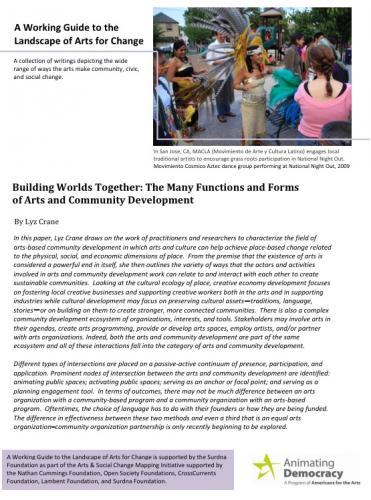 interactions fall into the category of arts and community development. interactions fall into the category of arts and community development.
Crane places different types of intersections on a passive-active continuum of presence, participation, and application. Prominent nodes of intersection between the arts and community development are identified: animating public spaces; activating public spaces; serving as an anchor or focal point; and serving as a planning engagement tool. Crane points out that, in terms of outcomes, there may not be much difference between an arts organization with a community-based program and a community organization with an arts-based program. Oftentimes, the choice of language has to do with their founders or how they are being funded. The difference in effectiveness between these two methods and even a third that is an equal arts organization–community organization partnership is only recently beginning to be explored.
Click here to download the whole document.
Read more »
Terms:2012, Arts & Culture, Business, CBC Report/Publication, Community Building, Community Development, Community Engagement, Creative Economy, Cultural Institutions, Featured, Other Reports/Publications, Placemaking, Public Art, Public-Private Partnerships

By Diana Nash of the Pink Line Project on July 12, 2012
There is a buzzword circulating in the DC arts scene that I had not heard about until I returned to the city two months ago. While the concept of using the arts to spur economic and community development is not new, DC is getting attention for the success of its “Arts and Culture Temporiums” since the first one launched along the H Street NE corridor in 2010. Temporiums fall under the larger category of the Temporary Urbanism Initiative, a project undertaken by the DC Office of Planning. The goal behind the initiative, and more specifically, temporiums, is to activate vacant or underutilized spaces by using them to showcase the talent of local artists and other creative entrepreneurs, along with the retail potential that lies within emerging neighborhoods. Think of them as “Pop Ups” that stay around a little longer and have greater potential benefits for the communities where they take place. Jessica Scheuerman, of Partners for Livable Communities, explains that temporiums allow people to “take risks, explore partnerships, and to commit to something” without the burden of a long-term commitment. Temporiums connect creative people seeking affordable space in their neighborhoods with landlords who have the available space that they haven’t been able to lease. It is a smart and increasingly popular concept that lays the groundwork for longer-term collaboration between property owners and neighborhood entrepreneurs.
Building on the success of earlier temporiums, the Office of Planning is targeting four emerging creative neighborhoods to benefit from a $250,000 grant to the city from ArtPlace, an unprecedented new private-public organization. ArtPlace is part of a national “creative place-making” movement that aims to drive revitalization across the country with arts at the center of economic development. The launch of DeanwoodxDesign marks the next step in the OP/ArtPlace grant initiative.
Read more »
Terms:2012, Announcements, Arts & Culture, CBC Press/Media, Community Building, Creative Economy, Culture Builds Communities, Neighborhood Revitalization, Other Events, Public Art, Washington, DC
 photo credit SCOPE photo credit SCOPE
SCOPE’s (Sarasota County Openly Plans for Excellence) mission is to connect and inspire citizens to create a better community. A private nonprofit, SCOPE is a convener, catalyst and facilitator, partnering with residents to generate collective action around issues affecting quality of life. It is fitting that Sarasota County, as the oldest in the nation and with 30 percent of its residents over 65, focuses considerable attention on aging. Founded in 2001, SCOPE collaborates with Sarasota County residents, elected officials, and community organizations to support broad-based undertakings led by citizens, to solve a variety of community concerns. Initiatives have addressed the environment, transportation, family violence, community change, and the needs of aging residents, to name just a few. All SCOPE activities address issues that strongly influence the quality of life in Sarasota County.
With Sarasota County’s large older adult population, it is not surprising that SCOPE’s perspective on aging is both positive and constructive. It views Sarasota County’s older adults as assets to and active participants in the community. In 2005, to examine the consequences of aging, the opportunities and challenges, SCOPE launched the initiative Aging: The Possibilities. Over 900 residents participated in many discussions, and presentations by experts covered a range of issues relevant to community planning for aging residents—and on their great capacity for enhancing the quality of life in Sarasota County.
Read more »
Terms:2012, Aging, Aging in Place, AIP Best Practice, Chamber of Commerce, City Leaders Institute on Aging in Place, Community Building, Housing, Philanthropy/Community Foundation, Public-Private Partnerships, Transportation
Age Friendly Cities
Rapidly urbanizing world populations are also rapidly aging. The number of people aged over 60 worldwide is expected to double from 11 percent to 22 percent by 2050 [i]. The need to adapt cities to meet the needs of an aging population is more important now than ever, and creating connected cities accessible for all ages is an integral part of responding to these demographic shifts. The World Health Organization (WHO) has been at the forefront of fostering responsible policymaking and networking related to aging in cities, and organized its Age Friendly Cities Project [ii] in 2005.
Read more »
|
|

