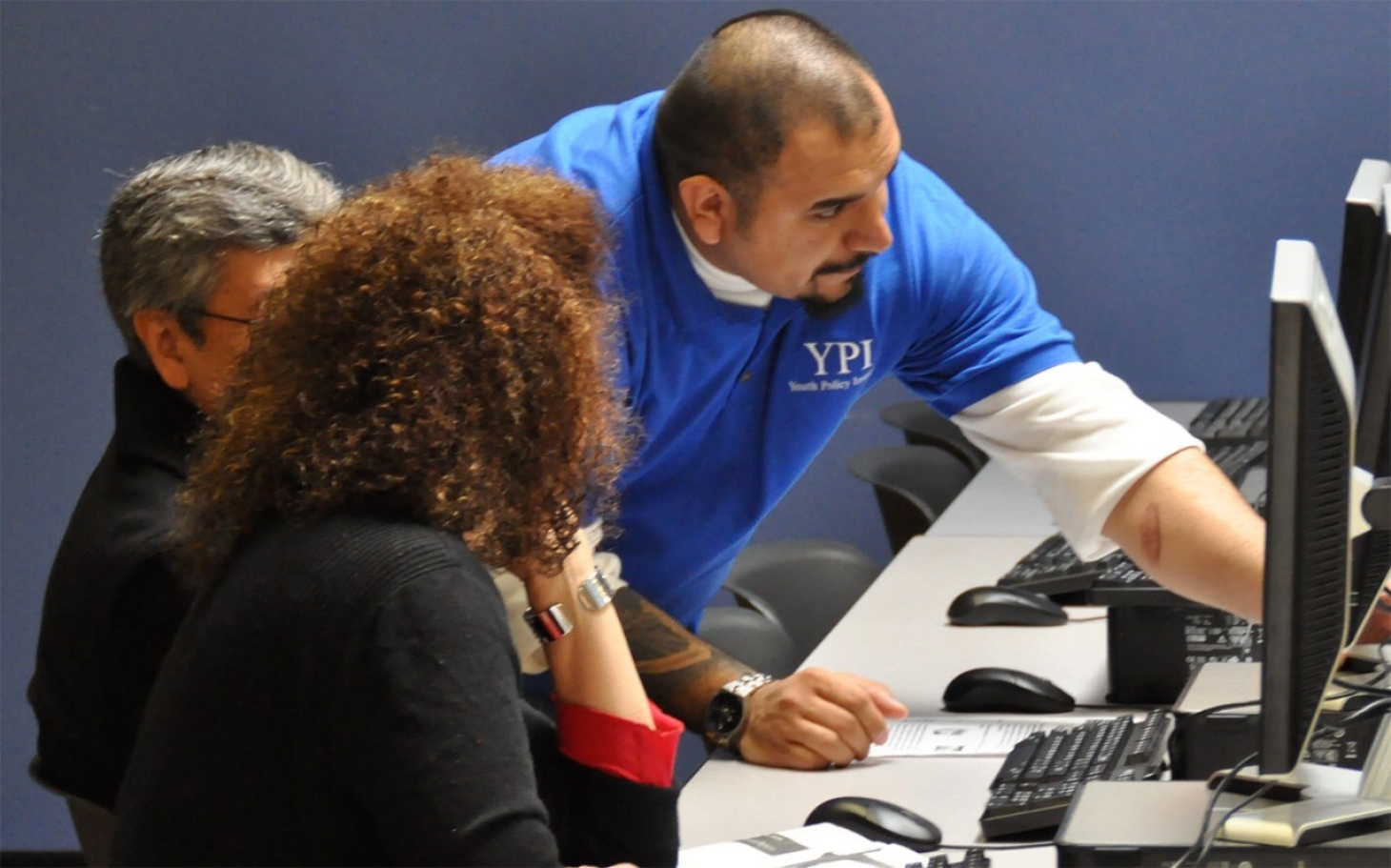
Partners in Progress: Initiative in Los Angeles creates one-stop shops for needy families (Photo credit: Al Jazeera America)
Will this be the Decade of Big City Growth?
William H. Frey, Brookings Institution
For the first third of this decade, big city population growth continues to outpace the rates of 2000 through 2010, according to new data released by the Census Bureau. It raises the question: Is this city growth revival here to stay? Or, is it a lingering symptom of the recession, mortgage meltdown and the plight of still stuck in place young adults? The new statistics, which update city populations through July 2013, give some credence to both theories."
Report: Keys to Successful Public-Private Partnerships
Daniel C. Vock, Governing
If there is any agreement in Washington about transportation funding these days, it is that any new federal funding will be hard to come by. That's why Congress and transportation experts are exploring how best to attract and use private money to pay for infrastructure projects.
A task force of the Eno Center for Transportation released a report last month looking at the nuts and bolts of making public-private partnerships (P3) succeed. Joshua Schank, the group's president and CEO, notes that the arrangements are not well-understood, even though they have been growing in popularity in recent years. "Many states still prohibit [public-private partnerships] and most others have little conception of how to manage one effectively in order to create benefits for both sides," he wrote in the report."
Jane Ellen Stevens, What Works for America's Communities, San Francisco Federal Reserve District
“Childhood trauma is a public health issue,” says Joyce Dorado, director ofHEARTS — Healthy Environments and Response to Trauma in Schools. “It’s really common, and the way kids react to it gets them into trouble in school.”
In fact, serious and chronic childhood trauma is so common that most people in the U.S. have experienced at least one type out of ten measured by the CDC’s Adverse Childhood Experiences Study. These include physical, sexual or verbal abuse; physical or emotional neglect; and five types of family dysfunction — family violence, living with alcoholic (or other drug-addicted) or mentally ill parents, losing a parent to divorce or abandonment, or a family member who’s in prison."
Partners in Progress: Initiative Creates One-Stop Shops for Needy Families
Haya El Nasser, Al Jazeera America
This one-stop shop for families in need requires partnerships among umpteen city, state and federal agencies, schools, businesses and nonprofit groups. But until now, agencies focused on one area — housing agencies on housing alone, education departments on schools alone, health agencies on medical care alone.
Now all these resources are coming together under a community quarterback, and the Youth Policy Institute is one. It’s a common-sense concept that seems so simple, it’s a wonder it has taken this long to become official."
Aaron M. Renn, The Urbanophile
I was in Columbus, Ohio for a couple days last week. I hadn’t been there since my late 2010 Columbus Metropolitan Club presentation, and so it was good to get to check in and see how they were doing.
I once called Columbus “the new Midwestern star,” noting that they were one of those Midwest cities that’s doing far better than the region’s reputation would suggest. It’s been growing at a reasonably rapid clip in both population and jobs, beating the US average significantly, though not measuring up to the Sunbelt boomtowns. Home to Ohio State, it’s educated to significantly above the national average, has a diverse white collar employment base, and is also an emerging logistics center among other good things."
Legal bees in the city have urban beekeepers abuzz
Whitney Pipkin, Elevation DC
Beekeepers in the city, their hives newly legalized, are helping the environment and making some sweet cash on the side. There’s nothing new about keeping bees in the city, says Toni Burnham. She brandishes a 1914 article fromPopular Mechanics magazine featuring a female stenographer running a “profitable bee farm” on a Philadelphia rooftop.
“Although the building is in the center of the business district and apparently miles from a pasture ground for the bees,” the article states, “they find the flowers somewhere, collect the honey and fly back to their hives without seeming to object at all to their metropolitan mode of life.”
Hopefully, the bees still feel the same about city life, because their presence in the District and other urban areas is on a steady rise."
The Need for Institutions to Measure the Value They Create in Their Communities
Kim Zeuli, Governing
Anchors that act as intentional drivers of social and economic growth create shared value. The concept of shared value recognizes that organizations and their communities are inextricably bound together and organizations do well by doing good. Anchor organizations that adopt a shared-value perspective will put into place operations and policies that simultaneously increase the organization's competitiveness and improve their communities' economic and social conditions...
...During the past year, the Initiative for a Competitive Inner City (ICIC), of which I am senior vice president, interviewed more than 70 anchor leaders and experts to better understand the benefits organizations realize from community initiatives and the metrics they use to track those returns. We identified four primary streams of benefits."
5 Crucial Principles for 21st Century Transportation Systems
Jonathan F.P. Rose, CityLab
Over the rest of the 21st century, cities will face many forces far beyond their control: mega-trends such as dramatic shifts in population, the financial vulnerability of a globally connected economy, resource scarcity, rising income inequality, and an increase in the droughts, floods, heat waves, cold waves, sea level rise, and storm surges caused by climate change. Preparing for all these stresses won't be easy, but a critical place to start is with urban infrastructure — an area where many U.S. cities are most vulnerable.
Infrastructure is the platform of the common good. It connects us in nested networks of systems, integrating homes, neighborhoods, cities, regions, and nations. Cities thrive with internal and external connectedness, and the backbone of this connectivity are our urban transportation systems. It's essential that we begin now to plan, finance, construct, and renovate transportation systems that can respond to these emerging mega-trends. Here are five ways to rethink today's infrastructure for a successful tomorrow."
“Every street’s going to prioritize pedestrians,” says moveDC’s lovely fine print
Tanya Snyder, Greater Greater Washington
Livable streets advocates all over the country are buzzing about DC's far-sighted new transportation plan, called moveDC. Yesterday, Streetsblog sat down to interview some of the people responsible for writing and implementing the plan....
...I spoke to Matt Brown, the District Department of Transportation's new acting director; Colleen Hawkinson, strategic planning branch manager at DDOT's Policy, Planning and Sustainability Administration (PPSA); and Sam Zimbabwe, associate director of the PPSA.